In-Person
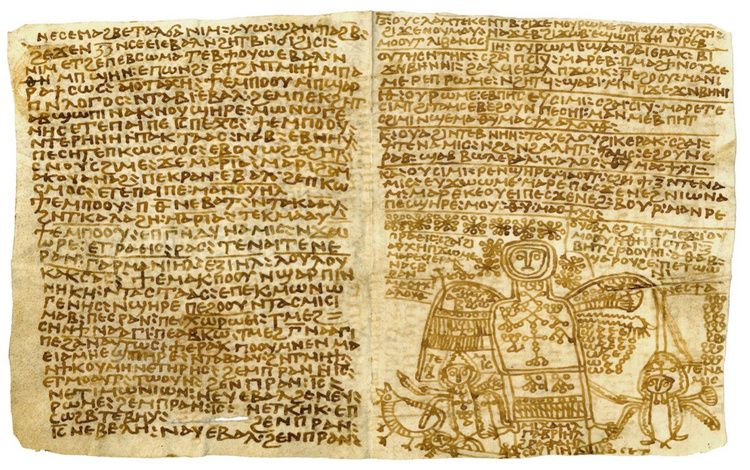
The Endoxon of Michael the Archangel (P.Heid.Inv. Kopt. 686): Monastic Scribes and the Ritualization of Michaelic Piety in Islamic Egypt
This event has passed.
406 Prospect Street New Haven, CT 06511
- Faculty
- Staff
- Students
Join us for a lunch talk with ISM fellow, Dr. Michele Scarlassara, that focuses on a Coptic manuscript at the heart of his book project, P.Heid.Inv. Kopt. 686 (=PCM I 26; Universität Heidelberg, Institut für Papyrologie). This tenth-century parchment palimpsest was made by erasing and trimming a ninth-century liturgical lectionary into a single-quire handbook of twenty pages. The magical prayer written over it, known as Endoxon of the Archangel Michael, is said to be efficacious in healing those afflicted by demonic possession. The Endoxon resonates strongly with the vast corpus of Coptic homilies dedicated to the archangel Michael that circulated widely across the Nile Valley between Late Antiquity and the early Islamic period. The paper makes two arguments. First, the Endoxon emerges as an experimental expression of Michaelic piety cultivated by networks of clerical scribes operating across the Nile Valley. Second, the Endoxon was modelled on, and was likely performed in the setting of, the “occasional prayers” for the sick known from medieval Coptic euchologia.
This event is free, but registration is required. Lunch will be provided.
Open to Yale Community only. This talk is a part of the ISM's Fellows Lunch series.
Contact: Katya Vetrov
Speaker Bio:
Michele Scarlassara received his Ph.D. in Asian and North African Studies from Ca’ Foscari University of Venice. Prior to joining Yale, he was a fellow at the Center for the Study of Christianity at the Hebrew University of Jerusalem.
His research explores the intersections of Christianity, Judaism, and other religious traditions in Late Antiquity, with particular attention to the interplay between liturgy, material culture, and ritual practice (e.g., amulets and incantation bowls). He has published articles in leading journals in the field, including Journal of Aramaic Studies and Studies in Late Antiquity. In 2023, he received the “Anna De Sio” prize for excellence in the historical study of religions.
While at the ISM, he will work on his monograph, Servants of God and Mammon: Magic and the Making of Christian Liturgy in Late Antiquity. The project explores the fourth to seventh centuries, a period widely recognized as a crucial formative phase in the development of Christian liturgical practice, through the lens of so-called “magical” sources. Although the emergence, development, and performance of core liturgical rites such as baptism, the Eucharist, and anointing of the sick are only partially understood, this body of sources offers an invaluable window onto these processes. Drawing on a wide range of texts and material objects from Christian Egypt and Syria-Mesopotamia—including amulets, prayers, ostraca, and ritual handbooks—as well as normative and narrative sources such as hagiography, homilies, and ecclesiastical canons, the project demonstrates the close entanglement of liturgy and ritual power in Late Antiquity and shows how these materials are key to reconstructing this creative phase in the history of Christian liturgical discourse.