One student's reflections on the ISM's study tour to France

Nora France

Izzy Barbato, M.M. ’26 and Phoebe Rendon-Nissenbaum, M.A.R. ’26, sharing an umbrella by the steps of the Pantheon on our first day in Paris.

Every other year, the ISM takes the entire student body on a study tour somewhere in the world. This time is often said to be the highlight of the student experience at the ISM. In June 2025, accompanied by faculty and staff, the students traveled to France where they spent two weeks exploring sacred sites in Paris and Marseille. In the year prior to the tour, students learned about French culture and life through speakers in colloquium, student presentations, courses, and performances (including the fabulous “Sous le ciel de Paris” concert by the Yale Voxtet). 

Nora Heimann ‘26, who is studying for the Master of Divinity degree from the ISM and Yale Divinity School, shared some of her own highlights of the trip. Read on!

Nora Heimann France trip

 Örgü Dalgiç (left) and Nora Heimann M.Div. ‘26 before the newly reopened Notre Dame de Paris.

“After a tiring journey across the Atlantic, we arrived in Paris to scudding rain. Nevertheless, we soldiered on, jet-lagged but undaunted. Happily, our stalwart good spirits were rewarded when the rain clouds parted on our second morning. Standing before the massive façade of Notre Dame de Paris under a vivid cerulean blue sky, I marveled afresh with friend and fellow art historian, Örgü Dalgiç at the remarkable sense of history that pervades the Parvis Notre Dame – the ancient square facing the cathedral in the center of the Île de la Cité which rests on Gallo-Roman ruins and is marked by a small well-worn brass plate indicating point zero, the official landmark by which all distances in France are measured. Amidst a dense swirling crowd, I recalled my last visit to Notre Dame, just four weeks after a catastrophic fire almost destroyed the medieval edifice in April 2019. On that occasion, my husband John and I watched with fascination and sorrow from the Left Bank of the Seine as professional mountain climbers repelled the fire-ravaged walls of the sanctuary, working to unseat its huge stained-glass windows so that their incendiary-stressed mullions could be replaced.  Now, six years later, the restored cathedral looked majestic and serene once again. 

After passing under Notre Dame’s oldest doorway (the 12th century portal of Sainte Anne) and emerging from the shadows of its narrow vestibule into the cathedral’s vast nave, I found myself astonished by the transformation of the church’s 800-year old interior, as its once-dark limestone appeared restored to the blond brilliance of its medieval youth by the removal of centuries of soot. Bathed in the jeweled incandescence of gleaming stained-glass windows; lit with the glow of new state-of-the art LED lighting; and brightly ornamented with vibrant modern and contemporary liturgical furniture and art, the church’s walls, arcades, galleries, and vaults seemed magnificently radiant. 

(Photos below in order from left to right: Notre Dame de Paris: West façade looking up to the Gallery of the Kings, Rose Window in the Gallery of the Virgin, and West Towers; Vaults along the nave of Notre Dame de Paris, seen from the west entrance facing east towards the choir and apse; Luminously lit – the arcade, triforium gallery, and vaults of Notre Dame at the crossing of the nave and transept; Chantel Miller, M.A.R. ‘26; Emily Chan, M.A.R. ‘25; and Reginald Payne, M.A.R. ‘25, view the Chapelle de Salomon in the north aisle with a tapestry by Georges Braque, “Composition l’Oiseau” (1963, woven 1968, on loan from Gobelins.)

  • Heimann France trip
  • Heimann France trip
  • Heimann France trip
  • Heimann France trip
Heimann France trip

The new Reliquary Chapel in Notre Dame de Paris, installed 2024, for the veneration of the Crown of Thorns and the relics of the Passion.

Despite the constant flow of eager visitors around me, I found an oasis for quiet prayer in the hushed Reliquary Chapel in the eastern apex of the ambulatory behind the cathedral’s high altar. There, I contemplated Notre Dame’s restoration in the presence of some of the Catholic Church’s most venerable objects, the holy relics of Christ’s Passion, including the Crown of Thorns. First brought to Paris from Jerusalem in 1239 by King Louis IX and saved from the flames in 2019 by the chaplain of the Paris Fire Brigade, the Crown of Thorns was placed after Notre Dame’s reopening in December 2024 behind a new altar screen of gilded cedar embedded with a glowing halo of cabochon glass.  In this luminous contemplative space, I felt a wave of gratitude for the cathedral’s historic witness to resurrection from ashes into new life. 

Heimann France trip

Jacob Ihnen, M.Div. ’25, Lily Rockefeller, M.Div. ’25, Sophia Spralja, M.A.R. ’26 in the Louvre studying the legendary sword of Charlemagne,. 

In the following fifteen days—ten spent with our entire group of ISM students, professors, and staff, and five more days in a smaller group of two professors and 11 students on an optional monastic excursion—we traversed France and toured some of the most ancient and iconic, artful, and sacred places in Paris, Chartres, Arles, Marseilles, La Manche, and Solesmes. Along the way, we met with internationally renowned French musicians, scholars, curators, and conservators who generously shared with us their profound knowledge and care for the cultural patrimony of France entrusted to their care. Our adventures included a memorable private tour of the Musée du Louvre’s unparalleled late antique, early Christian, and medieval collections led by Dr. Florian Meunier, the Louvre’s chief curator of Medieval and Roman Decorative Arts, who guided us at a clipping gait through the museum’s vast corridors from north to east, introducing us along the way to such remarkable treasures as the Joyeuse, the legendary “sword of Charlemagne” employed in French coronation ceremonies for over five and a half centuries.

Heimann France trip

Dr. Florian Meunier pointing out details related to the rock crystal, gilded silver, pearl and gem encrusted “Vase d’Aliénor.

The Vase d’Aliénor (Vase of Eleanor), the only known artifact of Eleanor of Aquitaine (ca 1122-1204), who gave the spectacular rock crystal vessel to King Louis VII of France in 1137 as a nuptial gift; and the Vierge à l’Enfant de Jeanne d’Évreux [Virgin and Child of Jeanne d’Évreux], in which the Blessed Virgin Mary appears both as an elegant French sovereign holding a jeweled scepter and as a loving mother tenderly supporting her infant, the Christ Child, who responds by tenderly touching her face with his tiny fingers. This sumptuous sculpture, rendered in gilded silver, pearls, jewels, and translucent enamel, was bestowed in 1339 by Queen Jeanne d’Évreux upon Abbot Suger, founder of the Gothic style at the royal Abbey of St Denis. 

(Photos below from left to right: Curator Florian Meunier illuminating the earliest known example of French translucent enamelwork in depictions of the life of Christ on the base of the Vierge à l’Enfant de Jeanne d’Évreux; Les Alyscamps, Arles; Beverly Love, M.Div. ‘26, in the garden of the former Arles hospital where Vincent van Gogh stayed in June 1889; Garden of the former Arles Hospital.)

  • Heimann France trip
  • Heimann France trip
  • Heimann France trip
  • Heimann France trip
Heimann France trip

Vault mosaics, Notre-Dame de la Garde (known affectionately as la Bonne Mère (the Good Mother). 

Away from the swift pace of Paris, the last days of our group trip were spent in sun-drenched Provence, where we toured the ancient Roman ruins and 19th century gardens of Arles; the most venerable churches and newest museums of Marseille; and the beautiful rock-lined inlets and breathtaking cliffs of Cassis. It was in Marseille that the ISM’s main tour of France ended on the last day of May. For some of us, however, our ISM journey continued with an optional excursion. I was fortunate to be granted the chance to stay on with ten other students to journey to two historic monastic communities in northwest France under the infectiously enthusiastic leadership of two new ISM professors of liturgical studies, Dr. Nina Glibetic and Dr. Gabriel Radle. 

(Photos below from left to right: Museum of European and Mediterranean Civilizations walkway with view of the Mediterranean Sea; Cap Canaille overlooking the Mediterranean Sea and the bay of Cassis with Reginald Payne, M.A.R. ‘25, and Shantel Miller, M.A.R. ‘26). 

  • Heimann France trip
  • Heimann France trip
Heimann France trip

Mont Saint Michel seen from the surrounding sands at low tide. 

Together, we journeyed first to the tiny island of Mont Saint Michel in the bay of Brittany and Normandy, where we stayed at the foot of “la Merveille”, the marvelous Romanesque and Gothic Abbey that has been a pilgrimage destination for over 1,300 years. We then traveled inland to Solesmes in the Pays de la Loire region, where we sojourned as guests of the Benedictine abbey where monasticism and Gregorian chant were revived in the early 19th Century after suppression during the French Revolution. 

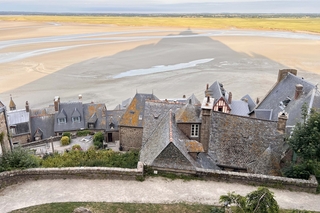
(Photos below from left to right: View from the abbey gardens of Mont St Michel (looking east), with the shadow of the Mont on the sand; Abbaye de Saint Pierre de Solesmes; Walking the perimeter of Mont Saint Michel; View from the monastery ramparts at dusk of the bay surrounding Mont St Michel.)

  • Heimann France trip
  • Heimann France trip
  • Heimann France trip
  • Heimann France trip
Heimann France trip

Compline with the sisters of the Monastic Fraternity of Jerusalem on Mont Saint Michel [Photo Gabriel Radle].

Set in sites of profound natural beauty that we explored together and on solitary rambles, our five additional days in France were idyllic, graced by the warm welcome we received by members of les Fraternités monastiques de Jérusalem at Mont St Michel and of the Abbaye Saint-Pierre and Abbaye Sainte-Cécile in Solesmes, who invited us to share in their sung, spoken, and silent worship; to enjoy simple but delicious meals in communal fellowship; and to learn about their experience of monastic life in thoughtful conversation. Mixing art and music, adventure and reflection, prayer and song, tranquility and joy, the end of our remarkable trip to France left me feeling both restored and inspired anew by the transformative power of faith nourished by the enduring inspiration of the sacred arts.”

(Photos below from left to right: Solesmes from the banks of the Sarthe River; Sr. Nathanael speaking with us about monastic life in the abbey garden at Mont St Michel; Choirmaster Fr. Paul Debout, discussing monastic life, the history of the abbey, and the revival of Gregorian Chant at Solesmes [Photo Sophia Spralja]; Sr. Beatrice, the welcoming Spanish nun staying at Sainte-Cécile de Solesmes, who was our guide and keeper of the keys to the Abbey Church). 

  • Heimann France trip
  • Heimann France trip
  • Heimann France trip
  • Heimann France trip

Nora Heimann M.Div. ‘26 is an art historian with a specialization in modern and contemporary art and critical theory at the intersection of culture, religion, identity, and politics. She trained at Harvard University (AB), Williams College Graduate Program in the History of Art (MA), the Université de Paris, and the CUNY Graduate Center (PhD). She is recently retired as professor of art history from the Catholic University of America and is an independent curator and museum educator with a focus on accessibility. Read more about Nora

Learn more about the ISM’s international study tours