Sacred Africana, Aquatic: Exploring Abundance and Scarcity Through Ritual in Burkina Faso, Cuba, and Haiti

- Introductions: Lav Kanoi
- Presentation I: Christina Taïna Désert
- Presentation II: Meredith F. Coleman-Tobias
- Presentation III: Maya J. Berry
- Respondent: Rachel Elizabeth Harding
- Responses between panelists and Q&A from audience
Bios

Maya J. Berry is an Associate Professor of African Diaspora Studies in the African, African American, and Diaspora Studies Department at the University of North Carolina at Chapel Hill (UNC-CH). A dancer and anthropologist, her theoretical and methodological approach to scholarship is interdisciplinary with a geographic specialization in Cuba. Berry employs performance as a methodology and an analytical lens to focus on both the movements of Black collectives and the techniques of the body through which political praxis is enacted, allowing for an intersectional and intimate understanding of how Black collectives mobilize in modernity. In addition to her new book, Defending Rumba in Havana: The Sacred and the Black Corporeal Undercommons (Duke University Press 2025), and forthcoming co-edited volume, Fugitive Anthropology: Embodying Activist Research (University of Texas Press 2026), her published articles in the Journal of Latin American and Caribbean Anthropology, American Anthropologist, Dance Research Journal, Cuban Studies Journal, Cultural Anthropology, Black Diaspora Review, and Afro-Hispanic Review sit at the intersection of questions of anthropological methods, Black feminist praxis, Black political imagination, and embodied epistemologies. Her scholarship has been supported by the Ford Foundation, the Wenner-Gren Foundation, and the Institute for Citizens & Scholars, among others. Prior to joining UNC-CH, Berry was a postdoctoral associate at the Institute of Sacred Music at Yale University.

Meredith F. Coleman-Tobias is an Assistant Professor of Religion, Race, and Ethnicity in the Americas at Mount Holyoke College. She specializes in Caribbean and North American iterations of African Atlantic religious cultures. She is specifically interested in contemporary religious migrations, which she began to study during her tenure as a Fulbright fellow in Barbados. Her current research project focuses on Sobonfu Somé, a deceased Burkinabé spiritual teacher and leader based in Sacramento, California. Investigating Somé’s ritual work and ‘mission’ in Western countries over the last two decades, she examines African and non-African descendants’ intentional practice of Dagara spirituality in North America as a lens through which to understand historical and contemporary Africana religious formations. She is writing a comprehensive, spirituo-biographic manuscript documenting Somé’s life and work, “The Aquatic Life of Sobonfu Somé.” She brings to her research a background in community theater, and interrogations of performance, place-making and knowledge reproduction significantly inform her understanding of religious communities. Meredith’s research has been supported by the Forum for Theological Exploration, the Ford Foundation, the Louisville Institute, and the Social Science Research Council. Meredith earned her B.A. from Spelman College, M.Div. from Yale Divinity School, and Ph.D. from Emory University.
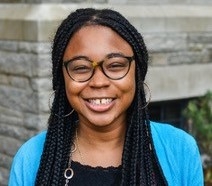
Christina Taïna Désert is a Ph.D. candidate in American Religious Cultures in the Graduate Division of Religion at Emory University. Her scholarship, an Africana practical theology, focuses on African heritage religions, particularly Haitian Vodou, with special attention to “motherness,” the poetics, and the environment. At Emory, she is a Centennial Scholars Fellow, and externally she has been awarded the Ford Foundation Predoctoral Fellowship. She received a BA in psychology and French from College of Saint Benedict, an MSW from Baylor University, and an MDiv from Harvard Divinity School.

Rachel Elizabeth Harding is a native of Georgia, a writer, historian and poet. Rachel is a specialist in religions of the Afro-Atlantic diaspora and studies the relationship between religion, creativity and social justice activism in cross-cultural perspective. A Cave Canem Fellow, she holds an MFA in creative writing from Brown University and a PhD in history from the University of Colorado Boulder. Dr. Harding is author of A Refuge in Thunder: Candomblé and Alternative Spaces of Blackness (Indiana University Press, 2000) as well as numerous poems and essays. Rachel’s second book, Remnants: A Memoir of Spirit, Activism and Mothering (Duke University Press, 2015), combines her own writings with those of her mother, Rosemarie Freeney Harding, on the role of compassion and spirituality in African American social justice organizing.
Dr. Harding co-directs the Veterans of Hope Project, a community initiative on religion, creativity and inclusive democracy.
Rachel Harding is Associate Professor of Indigenous Spiritual Traditions, Emerita in the Department of Ethnic Studies at the University of Colorado Denver.