Laboratory for Other Worlds


Erin Genia (she/her), an enrolled member of the Sisseton-Wahpeton Oyate, is a multidisciplinary artist, educator and community organizer specializing in Native American and Indigenous arts and culture. Genia’s work in these areas is focused on amplifying the powerful presence of Indigenous peoples in the arts, sciences and public realm to invoke an evolution of thought and practice that is aligned with the cycles of the natural world and the potential of humanity. Genia’s artistic practice merges Dakota cultural imperatives, pure expression, and exploration of materiality with the conceptual. Erin is fluent in multiple modes of expression: sculpture, fibers, sound, performance, digital media, writing, painting, printmaking, jewelry and ceramics. Her work has received attention from diverse audiences, and has been exhibited nationally and internationally, at the Urbano Project in Boston, the Venice Biennale, Ars Electronica and the International Space Station. Erin has an M.S. in Art, Culture and Technology from MIT, an M.P.A. in Tribal Governance from the Evergreen State College and studied at Institute of American Indian Arts. She was awarded the 2021 Traditional Arts Apprenticeship Grant from Mass Cultural Council, the 2019 MIT Solve Indigenous Communities Fellowship and the AAF Seebacher Prize for Fine Arts in 2018. Erin was recognized as one of the “ARTery 25 — Artists Of Color Transforming The Cultural Landscape” by WBUR in 2021. Erin’s public arts commissions include the Rose Kennedy Greenway, Boston University, the Minnesota Historical Society, the City of Saint Paul, and the City of Seattle. Genia lives and works in the greater Boston region, was a 2020 artist-in-residence for the City of Boston, and is a lecturer in the sculpture and performance department at the School of the Museum of Fine Arts at Tufts University.

Andrew Kemp’s (he/him) research aims to produce detailed reconstructions of sea level over the last 2000 years and in particular to determine the response of local, regional and global sea level to known climate deviations such as the Medieval Climate Anomaly, Little Ice Age, and 20th century warming. Dr. Kemp takes an interdisciplinary approach to this work using coastal stratigraphy, biological, and geochemical proxies, varied dating methods and quantitative paleoenvironmental techniques to reconstruct sea level. These records provide a constraint for future projections of sea-level rise. The Intergovernmental Panel on Climate Change (AR5) is consulting these reconstructions to place current and projected sea-level changes in an appropriate geological context. It is hoped these new geological data will aid coastal management under scenarios of future sea-level change.
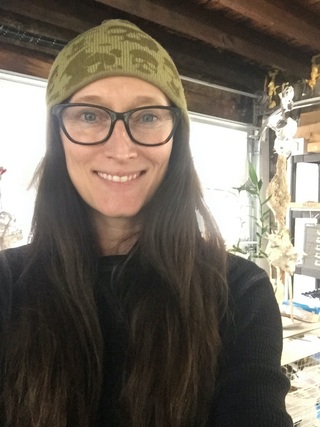
Patte Loper’s (she/her) work is informed by scientific research, folklore, and imaginative worldbuilding practices. She creates paintings and multimedia installations that reconfigure art histories to visualize entanglements between ecosystems and humans. As a lapsed Catholic and feminist utopian, her interest is in image construction that reads as religious and mythological, but that thematically explores frontiers of science and philosophy to contend with the intelligence of plants and microbes, the agency of matter, and how to live in a time of rapidly unfolding change. She currently lives and works in New York City and Boston, MA where she is on the faculty of the School of the Museum of Fine Arts at Tufts University. She has shown her work in numerous solo and group exhibitions nationally and internationally, including the Drawing Center (New York, NY), the Mattress Factory (Pittsburgh, PA), the Bronx Museum (Bronx, NY), the Tacoma Art Museum (Tacoma, WA), the Jordan National Gallery of Fine Arts (Amman, Jordan), and the Institute for Contemporary Art at the Maine College of Art and Design (Portland, ME). She has participated in residency fellowships at Yaddo, MacDowell and Lower Manhattan Cultural Council’s, and was a participant in the Drawing Center’s Open Sessions Program 2014-2016. She was a member artist of the Elizabeth Foundation for the Arts Studio Program from 2014-2019.